AllerSens
Skin Allergy Tracking Platform
Lesion severity segmentation, personalized ingredient safety scanning and product-lesion cross-analysis — under one AI-assisted dermatology intelligence roof.
What is AllerSens?
Skin Allergy Tracking Platform — AllerSens is an AI-assisted digital module suite for skin allergy and atopic dermatitis tracking. It offers lesion severity, ingredient safety and product-lesion cross-analysis under one roof with three integrated modules.
The modules run on photo-based AI segmentation, OCR ingredient reading and large language model (LLM) clinical commentary. All results support clinical decisions; they do not replace a medical diagnosis.
Three Integrated Modules
- EczemaTrack: BSA, erythema/edema/exudate/lichenification scores, PO-SCORAD/EASI from a lesion photo
- AllerGuard: Barcode/label OCR + cross-matching with patient allergens + risk level
- AllerTrack: Product label and lesion analyzed together → per-ingredient risk and mechanism
- Shared infrastructure: image segmentation, OCR engine, LLM clinical commentary
Technology: Segmentation + OCR + LLM
The platform combines image processing (segmentation), optical character recognition (OCR) and large language model (LLM) multimodal inference. The lesion is segmented by AI, the product label is read via OCR, and both are placed in clinical context by the LLM.
Workflow
- Image capture & quality check (lesion sharpness, label legibility)
- Lesion segmentation + label OCR reading
- Multimodal LLM inference: scores, ingredient list, risk, mechanism, clinical commentary
- Longitudinal tracking & trend comparison
Software-Centric Architecture
EczemaTrack — Atopic Dermatitis Tracking
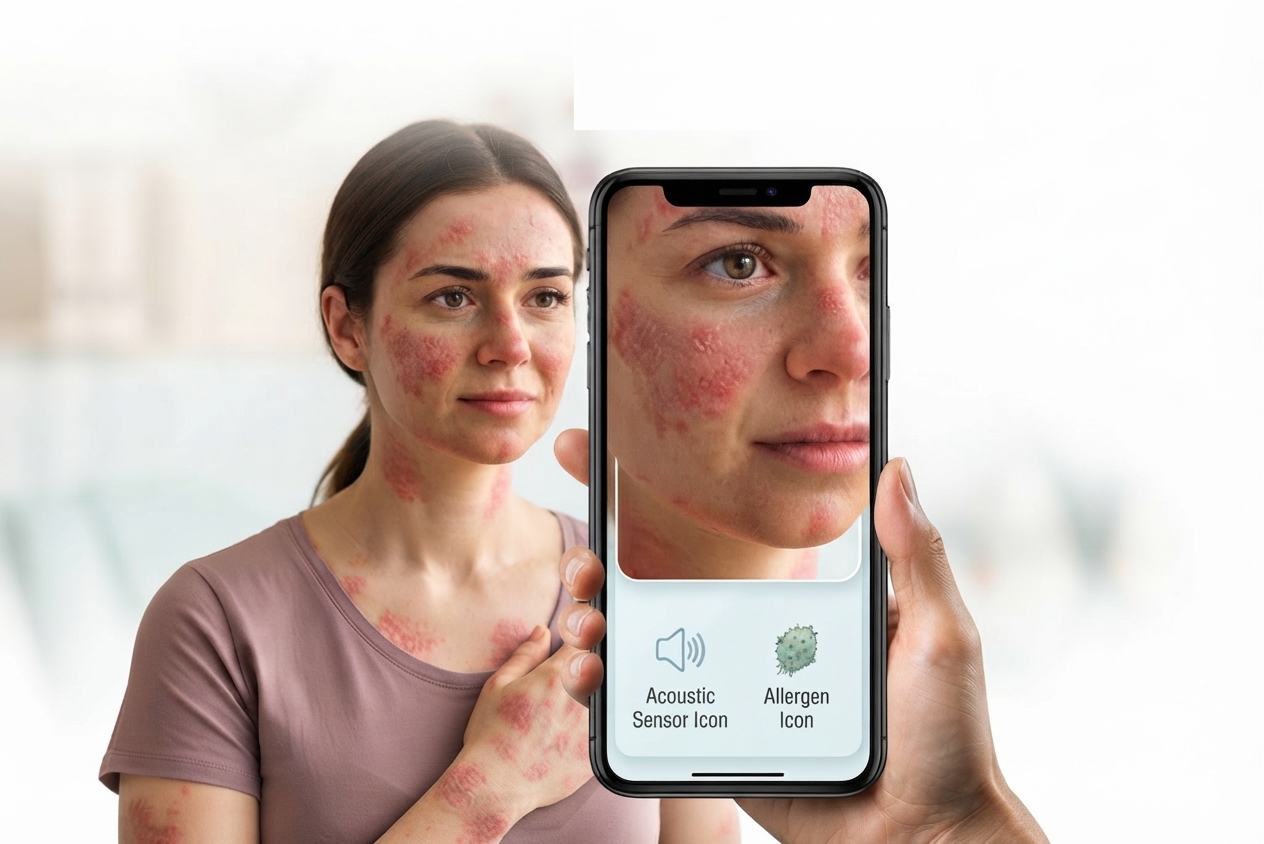
EczemaTrack automatically produces BSA involvement percentage, erythema/edema/exudate/lichenification scores and PO-SCORAD/EASI indices from lesion photos via AI segmentation.
PO-SCORAD formula: A/100×6 + (7×B/2) + C. A = extent (0-100→0-6), B = sum of 6 signs (0-18), C = subjective (0-20.7). EASI = region weight × (erythema+edema+exudate+lichenification) × BSA.
AllerGuard — Personalized Ingredient Scanner
AllerGuard reads cosmetic/skincare product barcodes or ingredient labels via OCR, cross-matches them with the patient's known allergens from patch testing and flags risky products.
The barcode (EAN/UPC) is read from the image; product name and brand are confirmed via an online database. Flagged allergens are ranked by patient profile and safe alternatives are suggested.
Risk Scale
- Low: no flagged allergens
- Medium: 1-2 flagged allergens
- High: 3+ flagged allergens or strong sensitizer
AllerTrack — Product-Lesion Cross-Analysis
AllerTrack analyzes the product label and lesion photo together; AI evaluates the ingredient's possible contribution to the lesion.
The label is read via OCR, the lesion is segmented by AI; each ingredient is evaluated for lesion mechanism (irritant, sensitizer, barrier disruptor) and per-ingredient risk percentage, role, confidence score and mechanism suggestion are provided.
Mechanism Categories
Clinical Value & Safety
The platform supports clinical workflows as a screening and decision-support tool. Lesion scores, ingredient risk assessment and cross-analysis provide the physician with structured, reproducible and comparable data.
Safety Architecture (Human-in-the-loop)
- AI output is not a diagnosis; it is information supporting the physician's assessment
- AI commentary contains no prescription/treatment advice
- Per-patient data isolation (RLS) and KVKK/GDPR-compliant sensitive data approach
- Physician approval required for high-risk findings
ESG & Roadmap
The software-centric architecture is compatible with EU carbon-reduction and ESG goals. Hardware independence brings medical consumable use close to zero.
Roadmap
Scientific References
The following studies demonstrate the clinical validity of atopic dermatitis scoring, contact dermatitis and ingredient allergenicity assessment.