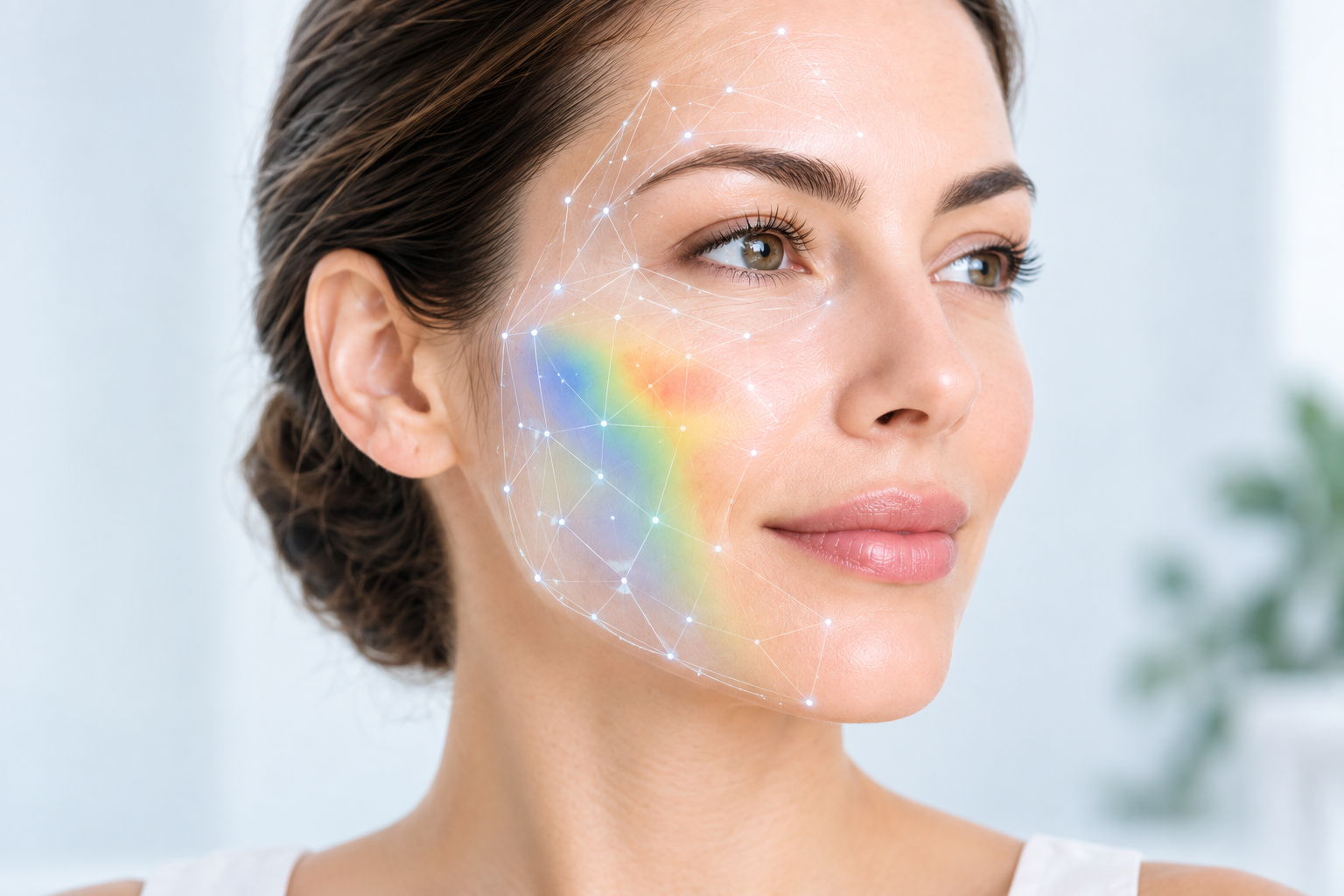
CosmetiGuard AI — Brochure
CosmetiGuard AI
AI-Powered Cosmetic Dermatology Suite

Smartphone-camera-based glow, pore, tone, wrinkle, hydration, hair, hand/nail analysis and cosmetic procedure suitability assessment; trend graphs and allergen-safe product recommendations — hardware-independent, mobile-first cosmetic dermatology intelligence.

Developed by Dr. Siyra Seren.
11 Expert ModulesCosmetic ProceduresHair & Hand/Nail
Table of Contents
1What is CosmetiGuard AI?
2Technology: AI Skin Analysis & LLM Inference
3Modules & Parameters
4Clinical Value & Decision Support
5ESG & Sustainability
6Scientific References
Vision
A software-centric, hardware-independent dermatology intelligence platform that produces clinically meaningful cosmetic skin assessment from consumer devices (smartphone, tablet).
Use Cases
In-clinic cosmetic tracking, teledermatology, product efficacy evaluation and community-based skin screening support.
1
Section 1

What is CosmetiGuard AI?

Product Response Tracking Platform — CosmetiGuard AI is an AI-powered imaging support tool that non-invasively assesses cosmetic condition from a standard skin, hair and hand/nail photograph. The system digitally analyzes glow, pore, tone, wrinkle, hydration, hair health, hand/nail, fat compartment volume loss, biological face age and cosmetic procedure suitability parameters to provide objective cosmetic assessment.

Skin surface texture and color signatures are quantified by AI models. Cross-polarized simulation separates sub-surface pigmentation and vascular structure visibility. Cosmetic product before/after response percentages enable objective product efficacy tracking.

Core Capabilities

  • 11 expert modules: GlowTrack, PoreGuard, ToneGuard, LineGuard, HydrGuard, Botox & Filler, FatPadMap, AgingMap, Eye Aesthetics, Hair Analysis, Hand & Nail
  • Glow, smoothness, pore, tone, wrinkle, hydration, hair, nail scores (0-100)
  • Rook/Christie skin type, Fitzpatrick phototype, Andre Walker hair type classification
  • Fat compartment volume loss, biological face age, eye area aesthetics assessment
  • Product before/after response tracking (%) and trend graphs
  • Patient allergen profile integration for allergen-safe product recommendations
Clinical Positioning
The system is a cosmetic assessment and decision-support tool; it does not replace a definitive medical diagnosis. AI models may err; outputs are produced to support a physician's clinical assessment. Final diagnosis and treatment decisions rest with the specialist physician.
2
Section 2

Technology: AI Skin Analysis & LLM Inference

The platform combines image processing and large language model (LLM)-based multimodal inference. From a standard RGB image, skin surface and sub-surface features are digitally extracted, enabling clinical-grade cosmetic assessment without additional hardware.

Processing Flow

  • Image capture & quality audit (brightness, contrast, sharpness)
  • Skin zone segmentation and feature extraction
  • Multimodal LLM inference: parameter scores, skin type, clinical commentary
  • Product response tracking: before/after % change and trend graph

Software-Centric Architecture

Hardware-Independent
Runs only on the smartphone's built-in camera; no extra medical hardware required.
Web-based (SaaS)
API-first architecture; integrates with EMR/cosmetic platforms, real-time remote monitoring.
AI Integration
Skin feature extraction + multimodal LLM for objective scoring and clinical commentary.
Telemedicine-Ready
Records stored as digital data; remote consultation and longitudinal tracking.
3
Section 3

Modules & Parameters

The platform consists of eleven expert modules: GlowTrack (glow & smoothness), PoreGuard (pore & sebum), ToneGuard (pigmentation & tone), LineGuard (wrinkle & elasticity), HydrGuard (hydration & barrier), Botox & Filler (procedure suitability), FatPadMap (fat compartments), AgingMap (aging map), Eye Area Aesthetics, Hair Analysis and Hand & Nail Analysis. Each parameter is reported as percentage/score.

GlowTrack
Glow score, smoothness, pore visibility, skin type, product response
PoreGuard
Pore count/size/density, T-U sebum, niacinamide compatibility
ToneGuard
Melanin/erythema index, tone unevenness, ITA°, pigmentation type
LineGuard
Wrinkle count/depth, dynamic/static, collagen, elasticity
HydrGuard
Hydration, desquamation, barrier damage, TEWL, moisturizer frequency
Botox & Filler
Procedure suitability, botox areas/units, filler areas/type, recovery
FatPadMap
Fat compartment volume loss, deep/superficial, filler strategy
AgingMap
Biological face age, wrinkle map, volume loss, ptosis vectors
Eye Aesthetics
Upper lid ptosis, lower bags, dark circles, tear trough, procedure recs
Hair Analysis
Hair type, porosity, density, breakage, scalp, shine, thickness
Hand & Nail
Nail color/surface/shape/brittleness, hand skin dryness/health, care plan

Output Format

  • Per module: parameter scores (0-100), skin/hair/nail type classification, clinical commentary
  • Cosmetic procedures: procedure suitability, fat compartments, aging map, eye area
  • Product response: before/after % change and trend graph
  • Hair & hand/nail: personalized care product recommendations
  • Allergen-safe product recommendations via patient allergen profile
  • Printable full report (PDF) and longitudinal trend chart
4
Section 4

Clinical Value & Decision Support

The platform supports clinical workflows as a cosmetic assessment and product tracking tool. Skin parameter mapping provides structured, reproducible and comparable data to the physician. Final diagnosis and treatment decisions always rest with the specialist physician.

Assessment
Objective skin, hair, hand/nail and procedure suitability scores + AI commentary.
Procedure Planning
Fat compartments, aging map, eye area and botox/filler planning.
Safety
Allergen-safe product recommendations (PatientAllergenProfile).

Safety Architecture (Human-in-the-loop)

  • AI output is not a diagnosis; it is information supporting the physician's assessment
  • AI commentary does not contain prescription/treatment recommendations
  • Per-patient data isolation (RLS) and KVKK/GDPR-aligned sensitive-data approach

Integration Scenarios

Teledermatology
Remote consultation, postoperative skin follow-up and recording from mobile devices.
Cosmetic Clinic
Product efficacy evaluation and personalized skincare recommendations.
5
Section 5

ESG & Sustainability

The software-centric architecture aligns with European Union carbon-reduction and ESG (Environmental, Social, Governance) goals. Hardware independence brings medical consumable use close to zero and reduces the carbon footprint from patients' physical travel through telemedicine.

Zero Hardware
Eliminates carbon from production-to-disposal of dermatoscope/polarized cameras.
Zero Consumables
No single-use probes/cannulas/apparatus; clinical waste near zero.
Digital Logistics
Web-based analysis removes the need for patient travel to the clinic.

Roadmap

Phase 1
Clinical deployment of 5 modules and product response tracking integration.
Phase 2
Deep-learning-based automated skin aging and risk scoring.
Phase 3
Personalized cosmetic care and predictive product efficacy analytics.
6
Section 6

Scientific References

The following studies establish the clinical validity and methodological foundations of image-based AI assessment in skin surface analysis, pore evaluation, pigmentation measurement and cosmetic dermatology.

1.Kania B, Montecinos K, Goldberg DJ. Artificial intelligence in cosmetic dermatology. J Cosmet Dermatol. 2024 Oct;23(10):3305-3311. doi: 10.1111/jocd.16538. Epub 2024 Aug 27.
2.Elder A, Ring C, Heitmiller K, Gabriel Z, Saedi N. The role of artificial intelligence in cosmetic dermatology-Current, upcoming, and future trends. J Cosmet Dermatol. 2021 Jan;20(1):48-52. doi: 10.1111/jocd.13797. Epub 2020 Nov 5.
3.Elder A, Cappelli MO, Ring C, Saedi N. Artificial intelligence in cosmetic dermatology: An update on current trends. Clin Dermatol. 2024 May-Jun;42(3):216-220. doi: 10.1016/j.clindermatol.2023.12.015. Epub 2024 Jan 4.
4.Gordon ER, Trager MH, Kontos D, Weng C, Geskin LJ, Dugdale LS, Samie FH. Ethical considerations for artificial intelligence in dermatology: a scoping review. Br J Dermatol. 2024 May 17;190(6):789-797. doi: 10.1093/bjd/ljae040.
5.Wei C, Adusumilli N, Friedman A, Patel V. Perceptions of Artificial Intelligence Integration into Dermatology Clinical Practice: A Cross-Sectional Survey Study. J Drugs Dermatol. 2022 Feb 1;21(2):135-140. doi: 10.36849/jdd.6398.
6.Caffery LJ, Janda M, Miller R, et al. Informing a position statement on the use of artificial intelligence in dermatology in Australia. Australas J Dermatol. 2023 Feb;64(1):e11-e20. doi: 10.1111/ajd.13946. Epub 2022 Nov 15.
7.Elder A, Ring C, Heitmiller K, Gabriel Z, Saedi N. The role of artificial intelligence in cosmetic dermatology-Current, upcoming, and future trends. J Cosmet Dermatol. 2021 Jan;20(1):48-52. doi: 10.1111/jocd.13797. Epub 2020 Nov 5.
8.Haykal D, Garibyan L, Flament F, Cartier H. Hybrid cosmetic dermatology: AI generated horizon. Skin Res Technol. 2024 May;30(5):e13721. doi: 10.1111/srt.13721.
9.Fliorent R, Fardman B, Podwojniak A, et al. Artificial intelligence in dermatology: advancements and challenges in skin of color. Int J Dermatol. 2024 Apr;63(4):455-461. doi: 10.1111/ijd.17076. Epub 2024 Mar 6.
10.Gordon ER, Trager MH, Kontos D, et al. Ethical considerations for artificial intelligence in dermatology: a scoping review. Br J Dermatol. 2024 May 17;190(6):789-797. doi: 10.1093/bjd/ljae040.
11.Landau M, Kassir M, Goldust M. Transforming Aesthetic Medicine With Generative Artificial Intelligence. J Cosmet Dermatol. 2025 Feb;24(2):e70015. doi: 10.1111/jocd.70015.
12.Li J, Li Y, Yan J, Yan L, Li Q. Artificial Intelligence in Non-Surgical Cosmetic Procedures: A Multi-Stakeholder Revolution. Aesthetic Plast Surg. 2026 Jun;50(11):4413-4430. doi: 10.1007/s00266-026-05689-3. Epub 2026 Mar 19.
13.Hash MG, Forsyth A, Coleman BA, Li V, Vinagolu-Baur J, Frasier KM. Artificial Intelligence in the Evolution of Customized Skincare Regimens. Cureus. 2025 Apr 18;17(4):e82510. doi: 10.7759/cureus.82510. eCollection 2025 Apr.
Odiosoft CosmetiGuard AI — Cosmetic Dermatology Platform
Developed by Dr. Siyra Seren · Contactless imaging · AI decision support · odiosoft.tech