PatchTrack
PatchTrack
AI-Assisted Digital Patch Test Tracking Platform

PatchTrack

Digital Patch Test Tracking Platform

Multi-panel OCR reading, standard capture, 48/72/96h time-series readings and ICDRG-based AI trend analysis — under one AI-assisted dermatology intelligence roof.

Developed by Dr. Siyra Seren.
Multi-Panel OCRICDRG ScoringTime SeriesHuman-in-the-loop
Table of Contents
1What is PatchTrack?
2Technology: OCR + ICDRG + Time Series
3Four-Phase Workflow
4ICDRG Scoring & Parameters
5PrickScan — Prick Test Wheal Meter
6Clinical Value & Safety
7ESG & Roadmap
8Scientific References
Vision
A hardware-independent AI dermatology platform that produces clinically meaningful patch test assessments from consumer devices (smartphone, tablet).
Use Cases
Patch test panel registration, standard back photo capture, 48/72/96h readings, ICDRG scoring and longitudinal trend analysis.
1
Section 1

What is PatchTrack?

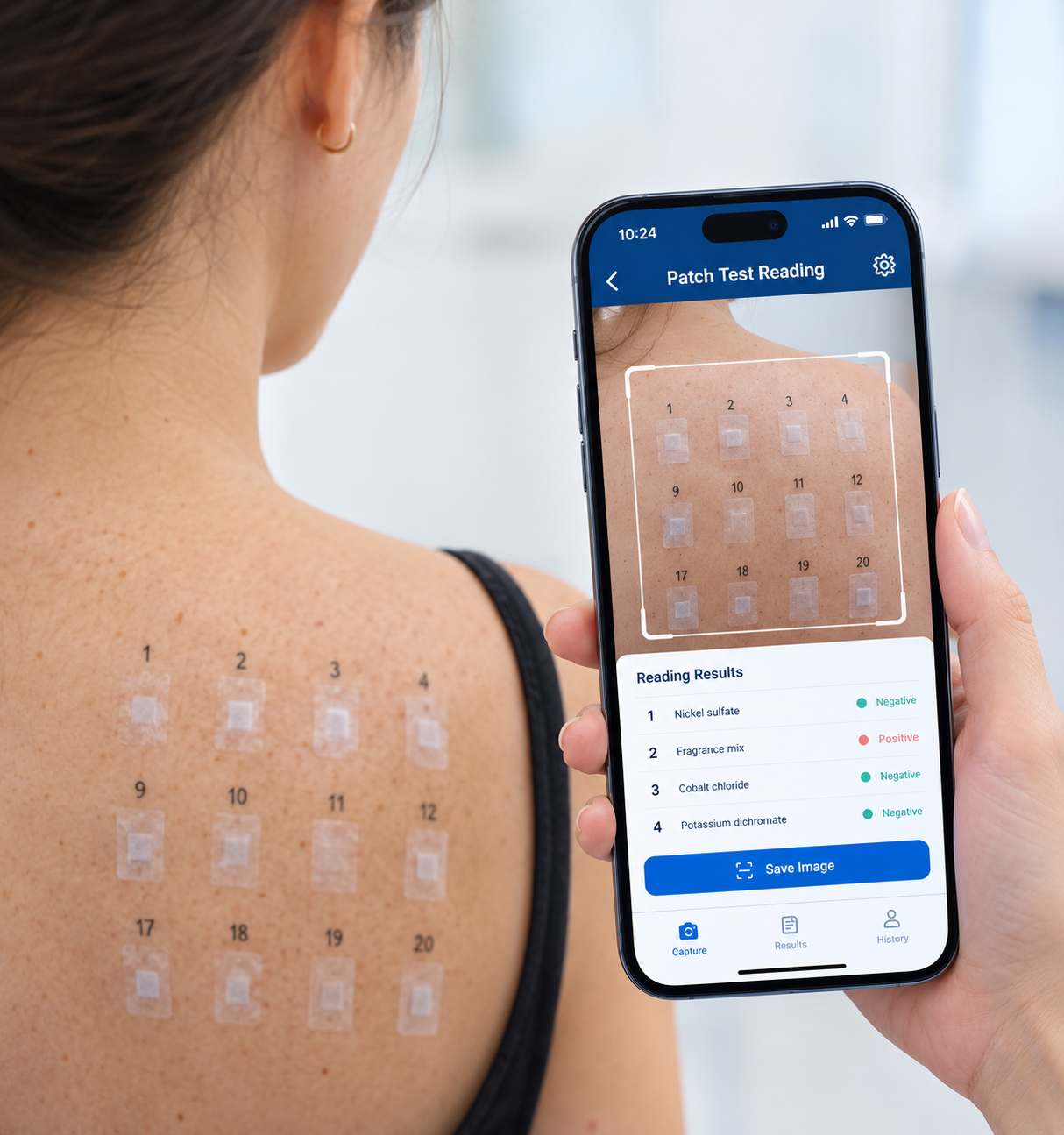
Digital Patch Test Tracking Platform — PatchTrack is an AI-assisted digital platform for patch test (epicutaneous test) tracking. It offers panel registration, standard capture, time-series readings and trend analysis under one roof with a four-phase workflow.

The system runs on OCR allergen list reading from panel photos, standard-format back photo capture, ICDRG scoring at 48/72/96h readings and LLM-based clinical trend commentary. All results support clinical decisions; they do not replace a medical diagnosis.

Core Capabilities

  • Multi-panel support — each panel's label, photo and allergen list saved separately
  • AI OCR allergen list reading from panel photos
  • Consistent time-series comparison via standard capture
  • 48/72/96h ICDRG scoring + papule/vesicle/area measurements
  • LLM-based clinical trend analysis and commentary
Clinical Positioning
The system is a screening and decision-support tool; it does not replace a definitive medical diagnosis. AI models can make errors; outputs are produced to support a physician's clinical assessment. Final diagnosis and treatment decisions rest with the specialist.
2
Section 2

Technology: OCR + ICDRG + Time Series

The platform combines optical character recognition (OCR), computer vision and large language model (LLM) multimodal inference. Panel photos are read via OCR, chamber reactions are detected via computer vision, and each time point is placed in clinical context by the LLM.

Processing Flow

  • Panel photo → OCR allergen list reading
  • Back photo → standard capture (reference)
  • 48/72/96h reading → ICDRG scoring (papule/vesicle/area)
  • Multimodal LLM inference: trend analysis and clinical commentary

Software-Centric Architecture

Hardware-Independent
Runs with the device's built-in camera; no extra medical hardware required.
Web-Based (SaaS)
API-first architecture; integrates with EMR/clinical systems.
Multimodal AI
OCR + computer vision + LLM for structured clinical output.
Telemedicine-Ready
Records stored digitally; remote consultation and longitudinal tracking.
3
Section 3

Four-Phase Workflow

PatchTrack divides patch test tracking into four phases. Correct execution of each phase ensures reliable time-series comparison.

1. Panel Registration
AI OCR allergen list reading from panel photos. Can be saved as templates.
2. Standard Capture
Standard-format photo of the patient's back with panels applied (reference).
3. Time Series
48/72/96h readings with standard capture. ICDRG scoring (papule/vesicle/area).
4. Trend Analysis
Cross-time-point comparison, trend arrows and AI clinical commentary.

Standard Capture Rules

  • Patient area centered, at a right angle
  • All panels within the frame
  • Good lighting, no shadows
  • Always the same distance (~30 cm)
4
Section 4

ICDRG Scoring & Parameters

For each chamber, ICDRG score (negative/doubtful/weak/strong/extreme), papule (0-3), vesicle (0-3) and reaction area (mm²) are measured. ICDRG scoring follows international standards (International Contact Dermatitis Research Group).

ICDRG Scale

−
Negative
±
Doubtful
+
Weak (Papule)
++
Strong (Vesicle)
+++
Extreme (Bulla)

Measured Parameters

ICDRG Score
− / ± / + / ++ / +++
Papule
0-3 score
Vesicle
0-3 score
Reaction Area
in mm²
Time Points
48h, 72h, 96h
Longitudinal Value
A patient's reaction changes across 3 time points are compared with trend tables and AI clinical commentary; increasing/decreasing/stable reactions and delayed positives are detected.
5
Section 5

PrickScan — Prick Test Wheal Meter

PrickScan detects the wheal-and-flare reaction in the photo after the skin prick test (SPT) using AI; measures the longest + orthogonal diameter and calculates the wheal area.

It is normalized with positive control (histamine) and negative control (saline). Normalized index = wheal area / histamine area. Wheal count, flare diameter and AI clinical commentary are provided.

Longest Diameter
mm
Orthogonal Diameter
mm
Wheal Area
mm²
Flare Diameter
mm
Normalized Index
wheal/histamine
Clinical Value
In prick testing, a wheal diameter ≥3mm is considered positive. The normalized index allows comparison of reaction severity across different allergens.
6
Section 6

Clinical Value & Safety

The platform supports clinical workflows as a screening and decision-support tool. ICDRG scores, time-series comparison and trend analysis provide the physician with structured, reproducible and comparable data.

Screening
Non-invasive patch test and prick test screening support.
Decision Support
ICDRG scores + trend analysis + clinical AI commentary.
Tracking
Longitudinal trend and time-series monitoring.

Safety Architecture (Human-in-the-loop)

  • AI output is not a diagnosis; it is information supporting the physician's assessment
  • AI commentary contains no prescription/treatment advice
  • Per-patient data isolation (RLS) and KVKK/GDPR-compliant sensitive data approach
  • Physician approval required for high-risk findings
7
Section 7

ESG & Roadmap

The software-centric architecture aligns with EU carbon-reduction and ESG goals. Hardware independence brings medical consumable use close to zero.

Zero Hardware
Eliminates dermatology device manufacturing-to-disposal carbon.
Zero Consumables
No single-use probes/apparatus; clinical waste near zero.
Digital Logistics
Web-based analysis makes the patient's clinic trip unnecessary.

Roadmap

Phase 1
Clinical rollout of the four-phase workflow.
Phase 2
Automatic exposure-correlation and flare early warning.
Phase 3
Personalized allergy tracking and predictive analysis suite.
8
Section 8

Scientific References

The following studies demonstrate the clinical validity of patch test ICDRG scoring, contact dermatitis and prick test assessment.

1.Wilkinson M, Gonçalo M, Aerts O, et al. The European baseline series and recommended additions: 2023. Contact Dermatitis. 2023 Feb;88(2):87-92. doi: 10.1111/cod.14255. Epub 2022 Dec 8.
2.Uter W, Aerts O, Agner T. European Society of Contact Dermatitis Guideline for Diagnostic Patch Testing-Recommendations on Best Practice (Update 2026). Contact Dermatitis. 2026 Sep;95(3):237-275. doi: 10.1111/cod.70195. Epub 2026 Jun 21.
3.Diepgen TL, Ofenloch RF, Bruze M, Bertuccio P, Cazzaniga S, Coenraads PJ, et al. Prevalence of contact allergy in the general population in different European regions. Br J Dermatol. 2016;174(2):319-329. DOI: 10.1111/bjd.14167
4.Thyssen JP, Linneberg A, Menné T, Johansen JD. The epidemiology of contact allergy in the general population—prevalence and main findings. Contact Dermatitis. 2007;57(5):287-297. DOI: 10.1111/j.1600-0536.2007.01220.x
5.Peiser M, Tralau T, Heidler J, et al. Allergic contact dermatitis: epidemiology, molecular mechanisms, in vitro methods and regulatory aspects. Current knowledge assembled at an international workshop at BfR, Germany. Cell Mol Life Sci. 2012 Mar;69(5):763-81. doi: 10.1007/s00018-011-0846-8. Epub 2011 Oct 14.
6.Natsch A, Gfeller H. LC-MS-based characterization of the peptide reactivity of chemicals to model the skin sensitization mechanism. Toxicol Sci. 2008 Dec;106(2):464-78. doi: 10.1093/toxsci/kfn194. Epub 2008 Sep 12.
7.Heinzerling L, Mari A, Bergmann KC, Bresciani M, Burbach G, Darsow U, et al. The skin prick test – European standards. Clin Transl Allergy. 2013;3(1):3. DOI: 10.1186/2045-7022-3-3
8.Seys SF, Hox V, Chaker AM, et al. Artificial Intelligence (AI)-assisted readout method for the evaluation of skin prick automated test results. Nat Commun. 2025 Oct 1;16(1):8637. doi: 10.1038/s41467-025-64334-w.
9.Justo X, Díaz I, Gil JJ, Gastaminza G. Prick test: evolution towards automated reading. Allergy. 2016 Aug;71(8):1095-102. doi: 10.1111/all.12921. Epub 2016 May 20.
10.Pineda J, Vargas R, Romero LA, Marrugo J, Meneses J, Marrugo AG. Robust automated reading of the skin prick test via 3D imaging and parametric surface fitting. PLoS One. 2019 Oct 21;14(10):e0223623. doi: 10.1371/journal.pone.0223623. eCollection 2019.
PatchTrack — Digital Patch Test Tracking Platform
Developed by Dr. Siyra Seren · AI decision support · odiosoft.tech