What Does the Software Do?
Odiosoft Respiro is an AI-powered, contactless upper airway, sleep and snoring health assessment platform. For a patient, only two photos — frontal and lateral profile — need to be taken; the system analyzes these images to produce anatomical and metabolic OSAS (Obstructive Sleep Apnea Syndrome) risk scores and morning sleep quality biomarkers within seconds.
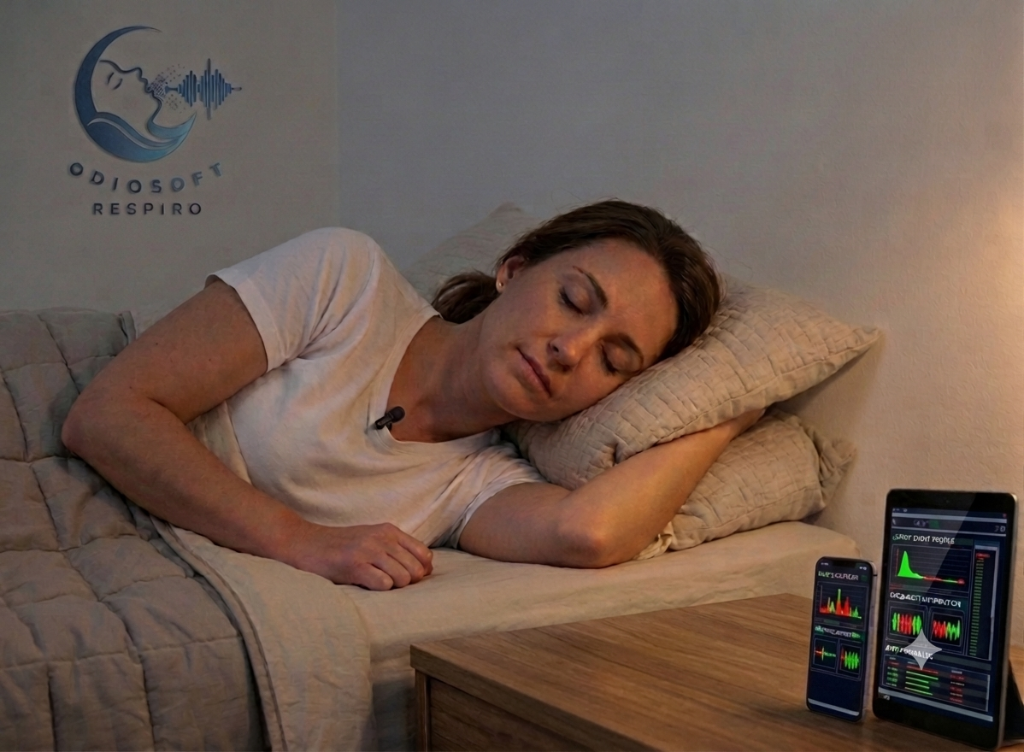
The software offers a holistic sleep health ecosystem with a module that detects anatomical narrowing sources from snoring sound recordings, a module that tracks snoring throughout the night, a module that measures sleep quality with morning facial biomarkers (dark circles, eye edema, skin pallor / turgor loss, ptosis) and a trend tracking module that compares the same patient's analyses on different dates. All results are stored digitally, can be converted to PDF reports and shared remotely.
Key Outputs
- Anatomical OSAS risk score (0–100%)
- Metabolic OSAS risk score and sleep quality estimate
- Morning sleep quality biomarkers (periorbital hyperpigmentation, eye edema, skin pallor, turgor loss, ptosis/redness)
- Snoring severity, frequency and anatomical source map
- Comorbidity (additional disease) risk score
- Date-based comparative trend analysis
In short, Respiro is a digital health software that performs snoring and sleep apnea assessment at the patient's side, with a mobile phone and without invasive sensors; it estimates overnight sleep quality with morning facial biomarkers.
What Is Analyzed?
Anatomical Analysis (Frontal + Lateral Profile)
- Neck angle and forward head posture (cervical angle)
- Jaw position — retrognathia/micrognathia detection
- Hyoid bone position and airway pressure risk
- Neck length and proportion to height
- Neck width / circumference (thick neck = risk)
- Submental (under-chin) fat tissue
Metabolic Analysis
- Insulin resistance estimate (high = adverse)
- Cortisol load (stress indicator)
- Mitochondrial energy (high = favorable)
- Systemic inflammation level
- Sleep quality score and metabolic OSAS risk
Snoring & Sleep Tracking
- Snoring episode count, duration, average and peak sound intensity (dB)
- Hourly snoring index and frequency distribution
- Anatomical source detection: tongue base, soft palate, uvula, epiglottis, nasal
- Comorbidities: hypertension, diabetes, heart disease, hypothyroidism, smoking, alcohol, sedatives, reflux
Morning Sleep Quality Biomarkers (Face)
- Periorbital hyperpigmentation — under-eye dark circle level
- Eye edema (swelling) — tissue fullness
- Skin pallor — loss of brightness/vitality
- Turgor loss — skin elasticity/dryness
- Ptosis/redness — eyelid drooping and capillary redness
- Sleep quality score — weighted average of 5 biomarkers
This multi-dimensional dataset evaluates anatomical structure, metabolic status, snoring and morning facial biomarkers together to create a comprehensive sleep health risk profile in a single session.
How Does It Work?
The patient uploads frontal and lateral profile photos to the system (or captures with camera). Images are uploaded to secure cloud storage and sent to a vision-capable large language model (vision LLM). The model evaluates the images together with the patient's demographic data.
Workflow Steps
- 1. Patient information (age, gender, height, weight, comorbidities) entered
- 2. Frontal + lateral profile photos uploaded
- 3. AI model analyzes images and clinical data together
- 4. Anatomical + metabolic parameters and morning sleep biomarkers produced
- 5. Percentage value, clinical explanation and severity label produced per parameter
- 6. Total anatomical/metabolic OSAS risk scores and sleep quality score calculated
- 7. Results saved, compared and exported as PDF
Morning Sleep Biomarkers
From frontal and lateral profile images, under-eye dark circles, eye edema, skin pallor, turgor loss and ptosis/redness are assessed; a weighted sleep quality score is derived from these five biomarkers. This enables a non-invasive estimate of overnight sleep quality from morning facial signs.
In Snoring Analysis
The snoring sound recording is spectrally analyzed with Fast Fourier Transform (FFT); sound intensity, frequency bands and spectral centroid are measured to classify the anatomical narrowing source. In overnight recordings, snoring episodes are automatically detected and their distribution over time is plotted.
The whole flow runs on cloud-based AI infrastructure; it is device-independent and can be used from any computer, tablet or phone with internet access.
Convenience & Innovation
Convenience for Patient and Clinic
- Fully contactless — no mask, sensor or nasal cannula needed
- Only two photos: assessment in 30 seconds, "white-coat effect" minimized
- Non-invasive sleep quality measurement with morning facial biomarkers
- Device-independent: phone, tablet or computer — no hardware investment
- At-home follow-up: self-assessment without going to hospital
- Ideal for pediatric and anxious patients, cooperation-free method
- Automatic reporting and date-based trend comparison
Innovation
Traditional methods produce only a single numerical parameter (airway resistance or cross-sectional area); Respiro produces a multi-parameter biomarker set from high-dimensional visual + clinical data. This structure provides an ideal digital biosignal base for running machine learning and deep learning models.
- Combines anatomical + metabolic assessment in one session
- Interprets visual + clinical data together with vision-supported multimodal AI
- Scalable platform for future AI models thanks to digital infrastructure
- Natural fit for tele-medicine and remote monitoring
ESG Features
Health systems produce about 4–5% of global carbon emissions; medical device production, single-use consumables and patient transportation are significant components of this footprint. Respiro dramatically reduces this load with its software-centric architecture.
- Zero hardware, low carbon footprint — software-focused approach
- Waste management — no probes, cannulas or single-use apparatus, clinical waste nearly zero
- Digital logistics — web-based analysis, no patient travel to clinic (tele-medicine)
- Digital data management — no paper reports, fully digital records
Carbon footprint management has become critical for corporate sustainability reporting (ESG) in the 2026 European market. Respiro's low hardware dependency, zero waste production and tele-health compatibility create a major advantage for ESG-focused health frameworks.
Difference From Other Snoring Tracking Software
Most snoring tracking apps on the market only record sound throughout the night with the phone's microphone and provide a one-dimensional statistic such as snoring episode count/duration. These apps cannot detect the source of snoring (anatomical narrowing region), cannot produce an anatomical/metabolic risk profile and cannot measure morning sleep quality biomarkers.
Respiro vs. Typical Snoring Apps
- Image + sound analysis vs. microphone sound recording only
- Anatomical narrowing source detection (tongue base, soft palate, uvula, nasal) vs. episode count only
- Anatomical + metabolic OSAS risk score vs. single snoring decibel/duration statistic
- Sleep quality measurement with morning facial biomarkers vs. no sleep quality measurement
- Comorbidity risk score and date-based trend vs. limited history
- Clinical decision support / triage tool vs. only "how much you snored yesterday" info
Strategic Positioning
Respiro elevates snoring tracking from a "sound counter" to a multimodal assessment platform that combines image + sound + clinical data. By revealing not only snoring severity but also its anatomical source and metabolic consequences, it offers physicians a meaningful triage and follow-up tool.
From an investor perspective: Respiro offers a scalable opportunity in both developed and developing markets as a digital health product that can grow without expensive hardware, transcends borders with tele-health and is ESG compliant.
Privacy & Medical liability
Privacy (KVKK / GDPR)
Facial data and voice data are sensitive personal data and are considered 'special category' data under KVKK (Turkey) and GDPR (European Union). Therefore, on-device processing of the data or anonymization before sending to the server is critical. Our system processes image and voice recordings only for analysis purposes; it is essential that biometric data is not shared with third parties and explicit consent is obtained.
- Facial and voice/biometric data — 'special category' under KVKK/GDPR
- On-device processing or anonymization before sending to the server should be preferred
- Explicit consent and data minimization: only necessary data is processed
- Data retention and deletion rights must be communicated to the user
Medical Liability
This system is an AI-supported analysis tool and can provide health/risk estimates to the user; however, it can never make a medical diagnosis (e.g. it should not say 'You have sleep apnea'). AI models can make errors; results are only supplementary information to support a physician's clinical assessment.
- AI-supported analysis — does not replace a definitive diagnosis
- Results are not medical advice; doctor consultation is required
- False positive/negative results are possible; the final decision belongs to the physician
- The decision to start or change treatment must be made only by a specialist physician
Results should be considered as a clinical decision support tool and used as a screening and triage layer that does not replace a physician examination or, when necessary, laboratory tests.