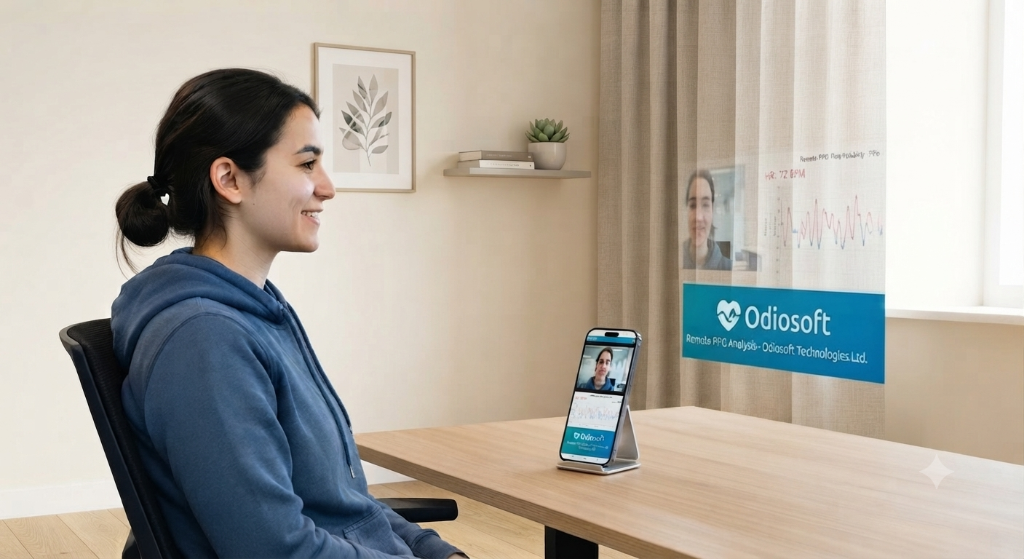
rPPG — Brochure
Remote PPG Analysis
Contactless Remote PPG Technology

Analyzing micro-color changes in the skin with a smartphone camera to measure heart rate, heart rate variability (HRV), blood pressure estimation and autonomic nervous system status.

Contactless MeasurementHRV & Autonomic AnalysisHuman-in-the-loop
Table of Contents
1What is Remote PPG?
2Technology: Optical PPG & Signal Processing
3Evaluated Parameters
4Clinical Value & Decision Support
5ESG & Sustainability
6Scientific References
Vision
A software-centric, hardware-independent photoplethysmography intelligence platform that produces clinically meaningful cardiovascular and autonomic assessment from consumer devices (smartphone, tablet, PC).
Use Cases
In-clinic screening, telehealth, postoperative follow-up, home-based remote monitoring and community-based early cardiovascular screening support.
1
Section 1

What is Remote PPG?

Contactless Cardiac & Autonomic Analysis — Remote Photoplethysmography (rPPG) is an AI-powered imaging support tool that non-invasively measures the cardiac pulse by detecting micro-color changes on the skin surface with a standard camera. With each heartbeat, the blood volume pumped changes hemoglobin absorption slightly; this change is captured by the camera.

The system filters the green channel waveform (0.65–3.5 Hz band-pass) to extract the pulse signal, determines heart rate via FFT analysis, and produces heart rate variability (HRV) metrics from RR intervals. Additionally, respiratory rate, blood pressure estimation and autonomic nervous system balance (LF/HF ratio) are computed.

Core Capabilities

  • Contactless measurement: no clinical probe/sensor required, only the device camera
  • Heart rate (HR), HRV (SDNN, RMSSD, pNN50), mean RR and LF/HF ratio
  • Blood pressure estimation (systolic, diastolic, MAP) and stress index
  • Respiratory rate and autonomic nervous system (sympathetic/parasympathetic) balance
Clinical Positioning
The system is a screening and decision-support tool; it does not replace ECG or clinical blood pressure measurement. AI models may err; outputs are produced to support a physician's clinical assessment. Final diagnosis and treatment decisions rest with the specialist physician.
2
Section 2

Technology: Optical PPG & Signal Processing

The platform combines image processing and digital signal processing (DSP). The green channel is extracted from the RGB image captured by the camera; this channel best reflects hemoglobin absorption changes. The signal is processed with detrend, band-pass filter and FFT analysis.

Processing Flow

  • Image capture & face region (forehead) ROI selection
  • Green channel average intensity extraction & detrend
  • Band-pass filter (0.65–3.5 Hz) & FFT heart rate detection
  • RR intervals → HRV metrics (SDNN, RMSSD, pNN50, LF/HF)
  • Additional: respiratory rate, blood pressure estimate, autonomic balance

Software-Centric Architecture

Hardware-Independent
Runs only on the device's built-in camera; no extra medical sensor/probe required.
Web-based (SaaS)
API-first architecture; integrates with EMR/clinical platforms, real-time remote monitoring.
AI Integration
Optical signal processing + LLM for clinical commentary and decision support.
Telemedicine-Ready
Records stored as digital data; remote consultation and longitudinal tracking.
3
Section 3

Evaluated Parameters

The analysis provides multi-layer parameters across heart rate, heart rate variability, blood pressure estimation, respiratory and autonomic nervous system groups. Each parameter is reported with a confidence score.

Heart Rate
HR (bpm), live waveform, FFT spectrum
HRV
SDNN, RMSSD, pNN50, mean RR interval
Autonomic Balance
LF/HF ratio, sympathetic/parasympathetic balance
Blood Pressure
Systolic, diastolic, MAP estimate, stress index
Respiratory
Respiratory rate (breaths/min)
Signal Quality
SNR, confidence score, recording quality index
Hardware Profile
FPS, resolution, hardware score
Clinical Commentary
AI clinical commentary and recommendations

Output Format

  • Per parameter: value, confidence score, description
  • Overall: heart_rate, hrv_metrics, bp_estimate, autonomic_status
  • Signal quality index (SQI) and hardware profile
  • Printable full report (PDF) and longitudinal trend chart
4
Section 4

Clinical Value & Decision Support

The platform supports clinical workflows as a screening and pre-triage tool. Cardiovascular parameter mapping provides structured, reproducible and comparable data to the physician. Final diagnosis and treatment decisions always rest with the specialist physician.

Screening
Community/clinic-based non-invasive cardiovascular screening support.
Decision Support
Structured HRV/HR parameters + clinical AI commentary.
Tracking
Longitudinal trend and cardiovascular change monitoring.

Safety Architecture (Human-in-the-loop)

  • AI output is not a diagnosis; it is information supporting the physician's assessment
  • AI commentary does not contain prescription/treatment recommendations
  • Per-patient data isolation (RLS) and KVKK/GDPR-aligned sensitive-data approach

Integration Scenarios

Telehealth
Remote consultation, postoperative follow-up and recording from mobile devices.
Early Screening
Cardiovascular early screening support; referral of high-risk cases to specialists.
5
Section 5

ESG & Sustainability

The software-centric architecture aligns with European Union carbon-reduction and ESG (Environmental, Social, Governance) goals. Hardware independence brings medical consumable use close to zero and reduces the carbon footprint from patients' physical travel through telemedicine.

Zero Hardware
Eliminates carbon from production-to-disposal of ECG/PPG sensors.
Zero Consumables
No single-use electrodes/probes; clinical waste near zero.
Digital Logistics
Web-based analysis removes the need for patient travel to the clinic.

Roadmap

Phase 1
Clinical deployment of the remote PPG module.
Phase 2
Deep-learning-based arrhythmia and anomaly detection.
Phase 3
Personalized cardiovascular follow-up and predictive analytics suite.
6
Section 6

Scientific References

The following studies establish the clinical validity and methodological foundations of remote PPG technology. Our platform draws inspiration from this literature but does not replace these methods.

1.Poh MZ, McDuff DJ, Picard RW. Non-contact, automated cardiac pulse measurements using video imaging and blind source separation. Opt Express. 2010;18(10):10762-10774. PMID: 20588490 DOI: 10.1364/OE.18.010762
2.Verkruysse W, Svaasand LO, Nelson JS. Remote plethysmographic imaging using ambient light. Opt Express. 2008;16(26):21434-21445. PMID: 19104553 DOI: 10.1364/OE.16.021434
3.Takano C, Ohta Y. Heart rate measurement based on a time-lapse image. Med Eng Phys. 2007;29(8):853-857. PMID: 17182256 DOI: 10.1016/j.medengphy.2006.09.005
4.Sun Y, Papin C, Azorin-Peris V, Kalawsky R, Hu S. Use of ambient light in remote photoplethysmographic systems. J Biomed Opt. 2012;17(7):077006. DOI: 10.1117/1.JBO.17.7.077006
5.McDuff D, Gontarek J, Picard R. Improvements in remote cardiopulmonary measurement using a webcam with remotely controlled lighting. IEEE Trans Biomed Eng. 2014;61(10):2575-2581. DOI: 10.1109/TBME.2014.2324996
6.Tarvainen MP, Niskanen JP, Lipponen JA, Ranta-Aho PO, Karjalainen PA. Kubios HRV—heart rate variability analysis software. Comput Methods Programs Biomed. 2014;113(1):210-220. PMID: 24205234 DOI: 10.1016/j.cmpb.2013.07.024
7.de Haan G, Jeanne V. Robust pulse rate from chrominance-based rPPG. IEEE Trans Biomed Eng. 2013;60(10):2877-2886. DOI: 10.1109/TBME.2013.2266196
8.Wang W, den Brinker AC, Stuijk S, de Haan G. Algorithmic principles of remote PPG. IEEE Trans Biomed Eng. 2017;64(7):1479-1491. DOI: 10.1109/TBME.2016.2609286
9.Rahman H, Uddin M, Ahmad M, Hasan M. Remote photoplethysmography: A review of recent advances and challenges. IEEE Rev Biomed Eng. 2022;15:21-43. DOI: 10.1109/RBME.2022.3162058
10.Chen X, Cheng J, Yang Y, Lu Q, Zhao R. Remote heart rate measurement using facial videos. J Healthc Eng. 2018;2018:5897249. PMID: 29854795 DOI: 10.1155/2018/5897249
11.Liu Q, Chen X, Wang J, Liu J. Heart rate estimation from facial videos under realistic conditions. IEEE Access. 2021;9:94289-94300. DOI: 10.1109/ACCESS.2021.3093366
12.Casalino G, Castellano G, Zoppoli R. Remote photoplethysmography and machine learning for cardiovascular monitoring: A systematic review. Artif Intell Med. 2023;143:102632. DOI: 10.1016/j.artmed.2023.102632
Odiosoft rPPG — Remote Photoplethysmography Platform
Contactless measurement · AI decision support · odiosoft.tech