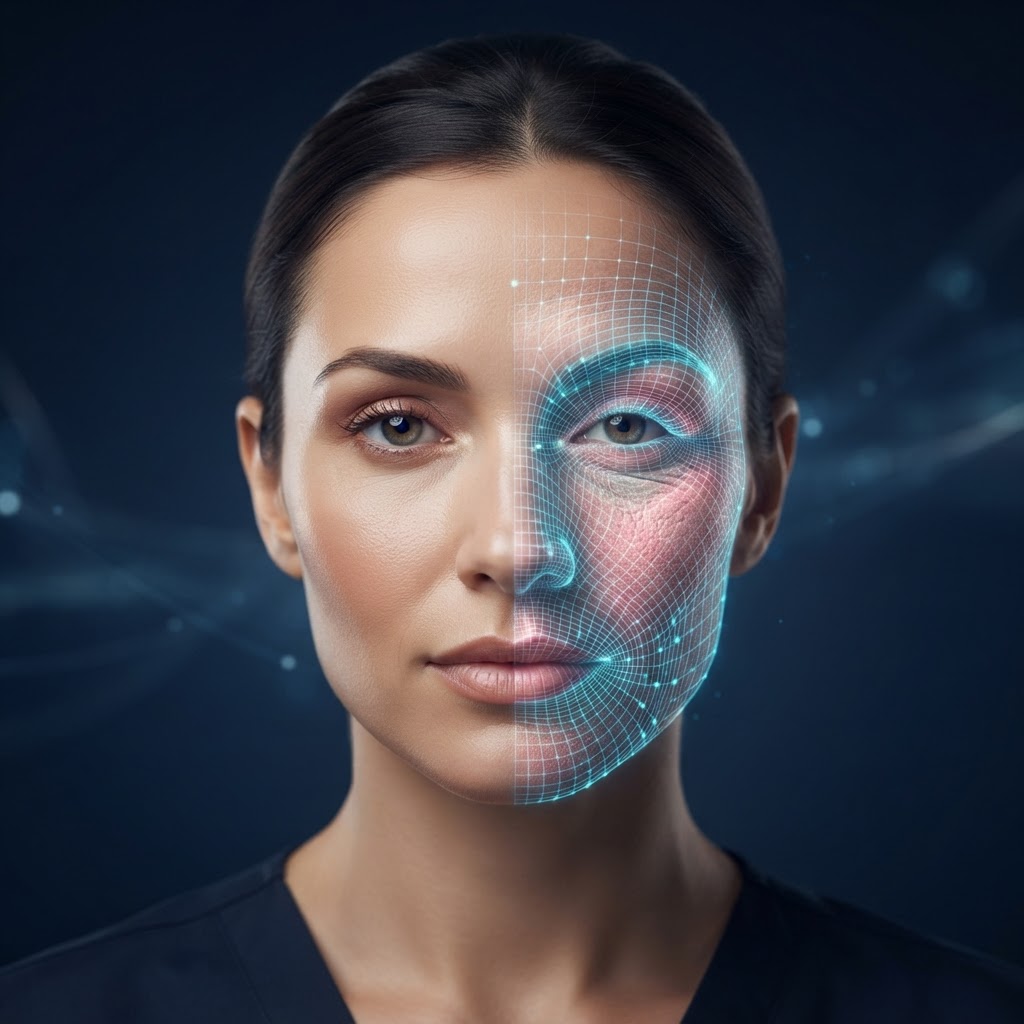
Contactless imaging, cross-polarization simulation and large language model (LLM) inference for skin surface/sub-surface assessment and clinical decision support.
What is Optic Skin Analysis?
Skin Health Platform — Optic Skin Analysis is an AI-powered imaging support tool that non-invasively assesses skin surface and sub-surface condition from a standard face photograph. The system digitally simulates cross-polarization logic to separate pigmentation, vascular structures, pores and sub-surface blemishes.
Geometric narrowing and tissue changes in the skin alter light reflection/scattering characteristics. Optic skin analysis quantifies these optical signatures through spectral and frequency-domain analysis to map melanin distribution, capillary visibility, wrinkle depth, sebum/pore status, collagen density, UV damage, hydration and barrier integrity across facial zones (forehead, cheeks, nose, chin, under-eye).
Core Capabilities
- Discrete surface (pigmentation, inflammation, pore, sebum) and sub-surface (vascular, blemish) assessment
- Zone-based (forehead, cheek, nose, chin, under-eye) percentage score and heatmap
- Overall skin health score, visual biological-age estimate and aging-speed indicator
- Optional side profile: asymmetry, jawline, neck skin and profile wrinkles
Technology: Cross-Polarization & LLM Inference
The platform combines image processing and large language model (LLM)-based multimodal inference. From a standard RGB image, polarized/reflection components and sub-surface information are digitally separated, enabling clinical-grade sub-surface assessment without additional hardware (polarized filters).
Processing Flow
- Image capture & quality audit (brightness, contrast, sharpness, face bounding box)
- Facial zone segmentation and zone-based feature extraction
- Multimodal LLM inference: parameter percentage, description, severity, zone scores, clinical commentary
- Summary metrics: skin_health_score, biological_age, aging_speed
Software-Centric Architecture
Evaluated Parameters
The analysis provides multi-layer parameters across surface, structure, pigment, lesion, barrier, functional, advanced and longevity groups. Each parameter is reported as percentage (0-100), description, severity and facial-zone scores, supporting both overall and region-focused assessment.
Output Format
- Per parameter: percentage, description, severity, zones{forehead, left cheek, right cheek, nose, chin, under-eye}
- Overall: skin_health_score (0-100), biological_age, aging_speed
- Face bounding box (face_bounds) for visual localization
- Printable full report (PDF) and longitudinal trend chart
Analysis Modules & Personalized Slots
The Optic Skin Analysis platform offers six integrated modules within a single analysis session. Each module combines AI inference with the patient's allergen profile to deliver end-to-end personalized clinical decision support.
Module Flow
- Skin Analysis → parameter mapping
- Longevity Analysis → biological age & aging speed
- AI-Assisted Diagnosis → differential diagnosis
- Skin Health Recommendations → personal care plan
- Content Scanner → product allergen screening
- Personalized Products → safe product recommendation
- Treatment Follow-up → severity & parameter trend
Clinical Value & Decision Support
The platform supports clinical workflows as a screening and pre-triage tool. Skin parameter mapping provides structured, reproducible and comparable data to the physician. Final diagnosis and treatment decisions always rest with the specialist physician.
Safety Architecture (Human-in-the-loop)
- AI output is not a diagnosis; it is information supporting the physician's assessment
- AI commentary does not contain prescription/treatment recommendations
- Per-patient data isolation (RLS) and KVKK/GDPR-aligned sensitive-data approach
Integration Scenarios
ESG & Sustainability
The software-centric architecture aligns with European Union carbon-reduction and ESG (Environmental, Social, Governance) goals. Hardware independence brings medical consumable use close to zero and reduces the carbon footprint from patients' physical travel through telemedicine.
Roadmap
Scientific References
The following studies establish the clinical validity and methodological foundations of image-based AI assessment of skin lesions and skin condition. Our optic skin analysis and nevus tracking platform draws inspiration from this literature but does not replace these methods.